Hitler's Defeat In Russia by Lieutenant-General Władysław Anders
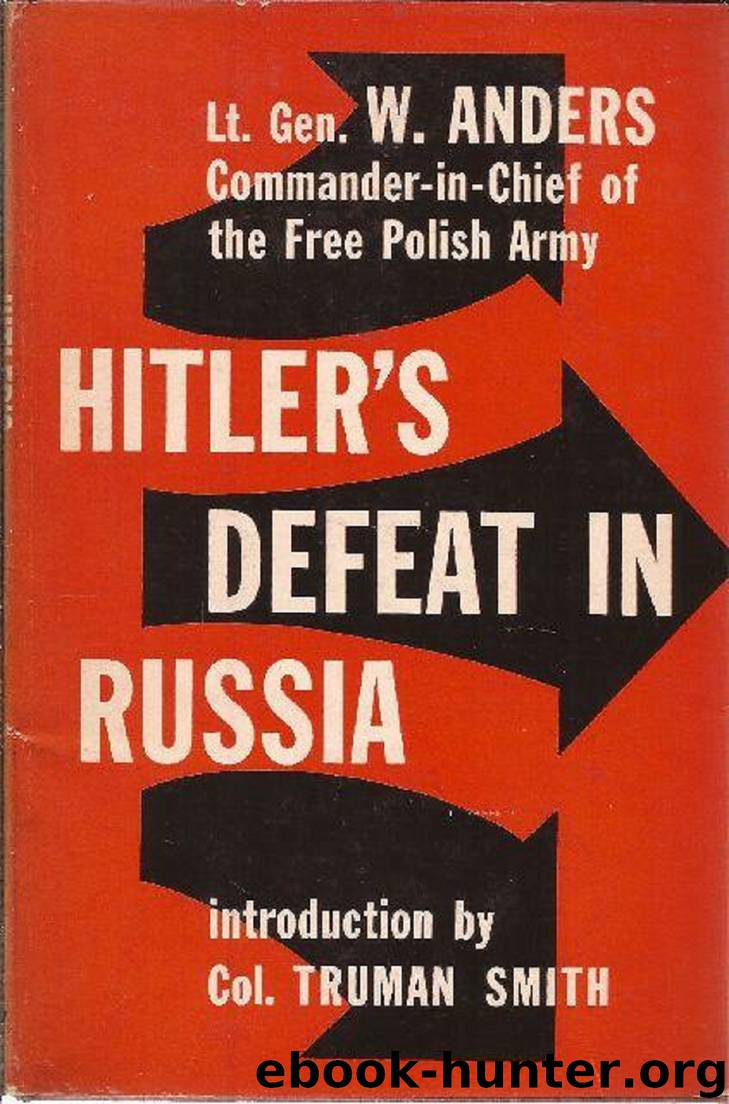
Author:Lieutenant-General Władysław Anders
Language: eng
Format: epub
Publisher: Pickle Partners Publishing
Published: 2015-11-13T16:00:00+00:00
A few days later, Field-Marshal von Manstein ordered General Hoth to discontinue the relief operation, to send part of his forces to the river Chir so as to save the situation there, and to begin an organized retreat with his main forces along the railway line Kotelnikovo-Salsk, in order to avoid endangering the southern flank of the Striking Group. Such was the end of the relief expedition. The planned thrust from the bridgehead at the mouth of the Chir was never launched. Nor did the Sixth Army try to break through. It was simply the death sentence for the forces besieged at Stalingrad. On December 29 the Russians captured Kotelnikovo. On January 1 their spearheads were approaching on both sides of the Don Tsymlanskaya, at the mouth of Tsymla, where a new front was being formed by the Task Group of General Hollidt{146} which had been driven from the river Chir.
Meanwhile, Hitler’s telegram ordering the Sixth Army to hold out at Stalingrad and await relief from outside, was generally accepted with resignation. Many of the commanders had doubts whether this decision was the right one. General Paulus, too, had misgivings, but decided to obey the order and was hacked by his Chief of Staff. However, the Commander of the LI Corps, General von Seydlitz, reacted in a different way. In his written report of the 25th to the Army Commander, he stated the reasons for the necessary and quick withdrawal from the trap, and demanded that General Paulus disobey Hitler’s order and break through with the army to the west; for, he maintained, the responsibility for the fate of hundreds of thousands of soldiers is greater than the duty of obedience to the superior in such circumstances.
When General Paulus turned down this proposal, General von Seidlitz decided to force his Army Commander’s hand by facing him with an accomplished fact. At the end of November he withdrew the left flank of his corps from good positions in the northern part of Stalingrad in order to shorten the corps’ front, and thus hoped to start the ball rolling and force the whole army to begin fighting its way through to the west. This attempt misfired, however. General Paulus stopped it quickly, reproached General von Seydlitz, and ordered him to move his troops back to their previous positions. The Russians took advantage of the chaotic movements which subsequently occurred, and attacked the German units which were maneuvering to and fro in the open steppe, and inflicted heavy casualties on them. The 94th Infantry Division ceased to exist; its remnants were incorporated by the 16th and the 24th Armored Divisions. The temperature was then 22 degrees below zero, Fahrenheit.{147}
The “cauldron” in which the Sixth Army was caught, was leaning in the east on the Volga in Stalingrad,{148} where the Russians succeeded in holding two small bridgeheads, one in the northern part of the city, the other in its center. To the west, the “cauldron” extended some 40 miles, and its depth was from 25 to 28 miles.
Download
This site does not store any files on its server. We only index and link to content provided by other sites. Please contact the content providers to delete copyright contents if any and email us, we'll remove relevant links or contents immediately.
| Africa | Americas |
| Arctic & Antarctica | Asia |
| Australia & Oceania | Europe |
| Middle East | Russia |
| United States | World |
| Ancient Civilizations | Military |
| Historical Study & Educational Resources |
The Sympathizer by Viet Thanh Nguyen(4447)
The Rape of Nanking by Iris Chang(4266)
World without end by Ken Follett(3512)
Ants Among Elephants by Sujatha Gidla(3495)
Blood and Sand by Alex Von Tunzelmann(3243)
Japanese Design by Patricia J. Graham(3220)
The Queen of Nothing by Holly Black(2660)
City of Djinns: a year in Delhi by William Dalrymple(2582)
India's Ancient Past by R.S. Sharma(2493)
Foreign Devils on the Silk Road: The Search for the Lost Treasures of Central Asia by Peter Hopkirk(2482)
Tokyo by Rob Goss(2469)
Inglorious Empire by Shashi Tharoor(2463)
In Order to Live: A North Korean Girl's Journey to Freedom by Yeonmi Park(2411)
Tokyo Geek's Guide: Manga, Anime, Gaming, Cosplay, Toys, Idols & More - The Ultimate Guide to Japan's Otaku Culture by Simone Gianni(2400)
India's biggest cover-up by Dhar Anuj(2381)
The Great Game: On Secret Service in High Asia by Peter Hopkirk(2375)
Goodbye Madame Butterfly(2289)
Batik by Rudolf Smend(2214)
Living Silence in Burma by Christina Fink(2094)
